


Scotland - 2026
Updated: Sep 3
A Journal of Slow Travel
Arrival in Scotland
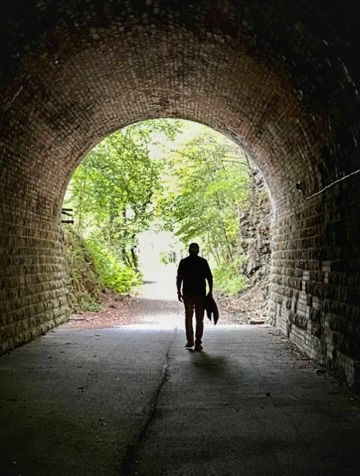
The return from an overseas trip usually stirs a mixture of emotions: disappointment that the adventure is over tempered by relief at being home. Our recent trip to Scotland was different. We came home relieved to sleep in our own bed, of course, but both of us were so enamored with Scotland that the disappointment of leaving was much stronger than usual.
After our spectacular house-sit in Wellow, England, the previous year, Martha had lined up two more housesits in the U.K., this time in Scotland. The first was in the village of Dunning, near Perth, and the second near the small town of Craigellachie, farther north. We built an itinerary around them: arrive in Edinburgh, spend time in a national park between the two housesits, and finish with a couple of days in Inverness. In all, we would be gone more than three and a half weeks.
Getting from Richmond to Dulles Airport is one of those logistical problems with several solutions, none particularly appealing. Rather than take the train and Metro, as we have in the past, we opted for an “off-clock” Uber driver we’d met named Mario.
Our flight was at seven in the evening, so we had Mario pick us up at one, giving us plenty of time. It was a Saturday and traffic was heavy. Mario also seemed unfamiliar with both where he was going and what he was doing. He initially had BWI punched into his GPS, then gave us an unexpected tour of West End Richmond before finally getting on the highway. A trip that normally takes two hours stretched closer to four.
We made the flight, but we still need to find a better way to get to Dulles.
The bag and security process was smooth and easy. We had to cool our heels at a concourse bar while waiting to get into the Etihad/Sapphire Lounge, which had a pleasant but fairly sparse food selection. Note to self: try the Capital One Lounge next time.
After our trip to Thailand in January, the eight-hour flight to London seemed almost leisurely. In the past, we’d stayed in London for a day or two to recover from the flight. This time, however, we waited four hours at Heathrow and caught a connecting flight to Edinburgh.
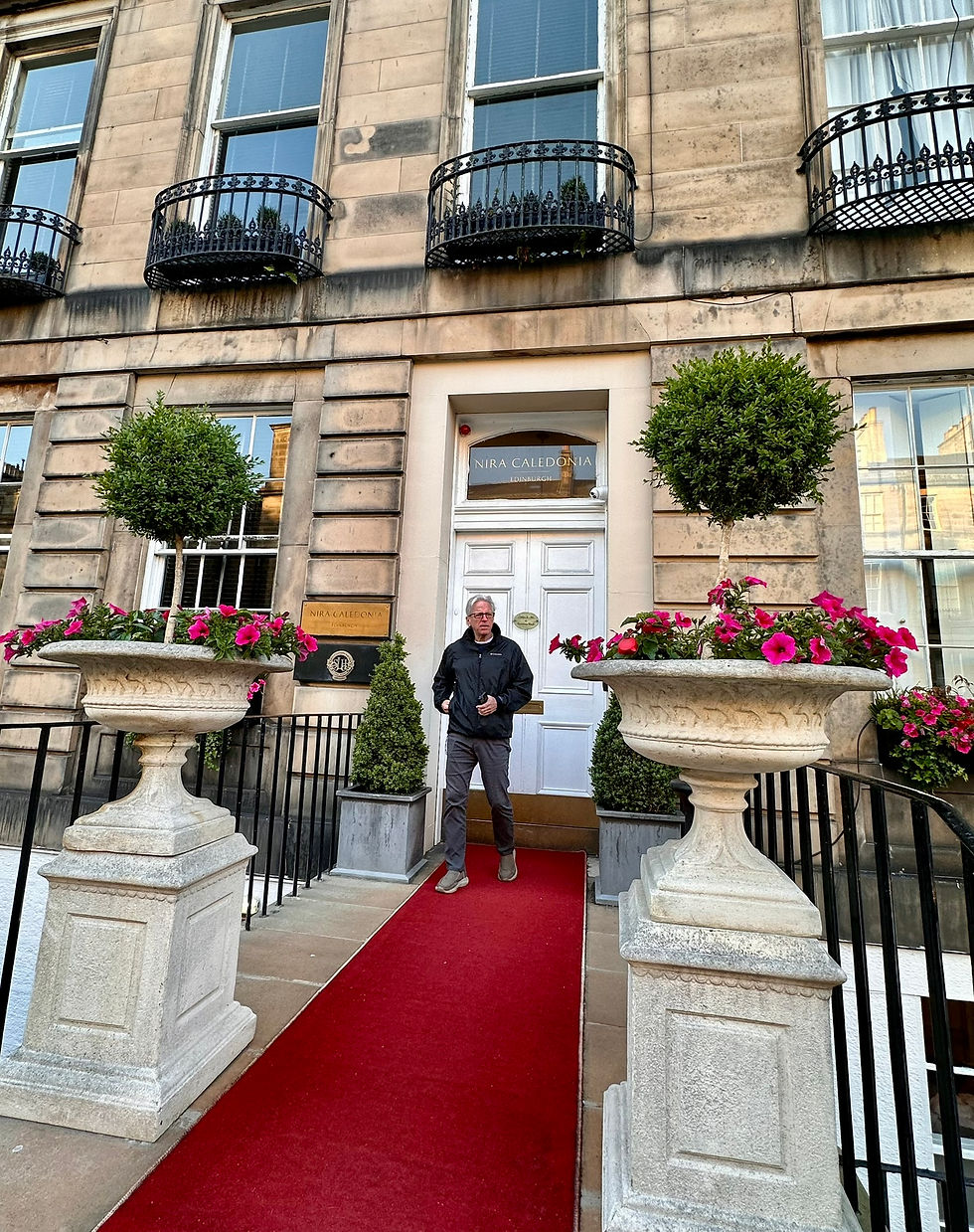
After nearly twenty hours of travel, we arrived at the Nira Caledonia hotel in New Town, utterly exhausted. It was a Hilton boutique hotel in a convenient but slightly out-of-the-way location. We took a short nap, then wandered through nearby Stockbridge and along the length of New Town before settling in for dinner at The Standing Order, a huge pub.

Our Uber driver had warned us about a concert that evening by American country artist Zach Bryan, which explained the knots of people wandering around in cowboy hats and boots. American country music is surprisingly popular in Scotland, and I began wondering about the Scottish roots of country and Americana music.

The next day, June 15, was our only full day in Edinburgh. We explored New Town and climbed up to Calton Hill with a number of monuments and an expansive view of the city, then met a fellow named Kenny, a bagpipe busker with a connection to Castle Park; longtime friend of CPA managers Mark and Rae Lawson. He positioned himself at Prince Street Gardens, a prominent thoroughfare in front of the Sir Walter Scott Monument where every tourist passes. He told us that bagpipes, which vary considerably in pedigree and quality, have only nine notes, limiting the range of tunes they can play.
We then visited the National Galleries, which were surprisingly good. We walked up into Old Town. It was beautiful, but also much too touristy for our taste. That evening we opted for Bailie’s in Stockbridge, near our hotel, which turned out to be a wonderful choice.
We were already beginning to discover something we would encounter throughout the trip: we really liked Scottish pubs.
Settling into Dunning
Frankly, we haven’t found many pubs in Britain that we don’t like. There is something about the relaxed, living-room atmosphere and easy camaraderie of U.K. pubs that is both welcoming and comforting. They seem less like businesses than extensions of the community—places where people drop in, know each other, and settle in for conversation.
The next morning we Ubered to Waverley Station for the train to Perth. We didn’t need to be at our housesit for several hours, so we took time to wander around Perth. It wasn’t particularly touristy or glamorous—more working-class and a little shabby—but it had its own charm.
Eventually we found a cab to the Enterprise car-rental location, picked up our Renault Austral hybrid, and headed toward Dunning.
I’d been anxious about driving in the U.K. The problem wasn’t really driving on the left. It was the narrow roads, roundabouts, unfamiliar signage, and highway interchanges. I’d taken the plunge the previous fall, and this time it seemed more manageable. Maybe familiarity helped, but the roads also seemed easier and less crowded.
We found Latchburn Ford and were greeted by our host, Patrick Heriot-Maitland, and our charge, Puffin, a very cute Tibetan Terrier.

As we were unpacking the car, we were interrupted by a van that pulled up in the drive. Patrick told us it was the ‘fishman,’ who came every Tuesday. The driver opened up his back hatch to a display of fresh fish for our selection. It was a bit like the old-style milkman—but with fish!
Patrick then showed us around his beautiful property. Covering several acres and filled with lush flower gardens, it was grander than our stay in Wellow the previous year, and also more formal. There were lots of knickknacks and decorations that reminded me of Martha’s mother’s house. Floral print wallpaper and upholstery, delicate porcelain figures on high-gloss furniture. They also had a stellar art collection that included paintings in a range of styles along with exquisite sculptures.
But there were similarities to Wellow, too. Dunning was a quaint old village with a welcoming pub and shop within easy walking distance. The house had a sunroom overlooking a bucolic landscape, with a windmill visible beyond the trees. The surrounding countryside was a series of rolling hills filled with sheep and bordered by hedgerows.
There is something about the villages of the English and Scottish countryside that feels more natural—more integrated with nature and the rhythms of life—than the artificial barriers and bubbles we often create in America.
Patrick fixed us a “spot of tea” and then took us for a drive to a nearby wood to walk Puffin. He showed us how the house worked. Then his wife, Daisy, joined us for drinks and prepared a marvelous chicken dinner. It was an extraordinary gesture, especially since they were getting up at five the next morning for a flight.
Life with Puffin
During our walk, Patrick told us to keep an eye out for red squirrels. They are native to Scotland and have been recovering from near extinction. Years ago, gray squirrels from America were introduced, bringing with them a trait that overwhelmed the native reds. Gray squirrels are now considered invasive and are being eliminated—shot, in fact—to protect the red squirrels.
The red squirrels, needless to say, are very cute.
One of the benefits of spending some introductory time with a housesit host is that you get both the lay of the land and a little local lore. The Heriot-Maitlands had a windmill just behind their property. It was enormous and visible from all over the valley.
Patrick told us about a local fellow, Simon Howie, who had started as an assistant in a local butcher shop, worked his way up, and eventually started his own business, which grew into a major meat-processing operation with retail outlets. Howie built the windmill to power his operation.
The hours of daylight were another adjustment. In mid-June, this far north, sunrise and sunset seemed disorienting. Dawn came around 4:30 in the morning and sunset was after 10:30 at night. Even during that brief night, it never became completely dark. Fortunately, our bedroom had blackout shades.
On our first full day in Dunning, June 17, I got up and walked Puffin into town. The village shop turned out to be more than adequate for everything we might need.


Like many English and Scottish villages, Dunning had a familiar arrangement: a cluster of homes, an old church, a few commercial shops, and a pub. Beyond them were rolling hills, mostly filled with sheep or cows. At the end of our drive was a field of sheep, all of them lifting their heads to stare curiously as we walked past with Puffin.
Dunning also had a town golf course, as did many Scottish towns. It wasn’t particularly large and felt more like a public park, with soccer fields nearby. Patrick told me I could walk Puffin around it as long as I stayed away from the golfers. That was something I couldn’t imagine at an American golf course.

We quickly fell into a routine. One of us would get up around seven or eight and walk Puffin. Then we’d decide on an outing—not far and not for long. There were plenty of local attractions, either historic or simply bucolic.
After a couple of hours out, we’d return to the house and settle in. It was such a charming setting there was little reason to do anything else. Eventually we’d make dinner or walk down to the pub. Martha worked on one of her recurring jigsaw puzzles while I read, wrote, or frittered on screens. Periodically, we’d wander around the grounds and soak in the gardens.
It was an easy, restful existence.
As I walked Puffin around Dunning, I began noticing the schoolchildren and teenagers coming and going in the morning and afternoon. They were all dressed in uniforms: white shirts, ties for the boys, skirts for the girls. It seemed universal here and almost unimaginable in the United States.
Discovering the Scottish Pace
On June 18, we put Puffin in the back of the car and ventured to Scone Palace, the historic site of Scottish royal coronations. The grounds were beautiful, with wooded gardens and peacocks wandering around.
That evening we made our first visit to the Kirkstyle Inn. As we often said of places like this, it was “terminally cute.” The pub was cozy and inviting, like someone’s living room where everyone comes to hang out. Locals greeted one another with hugs and laughter, sharing a pint and catching up. There was a sense of community that felt both casual and genuine.
That experience seemed typical of the Scots generally. They were quick to engage in conversation and familiarity.
One morning, while taking Puffin out, I stopped at the village shop for a coffee and a doughnut. The fellow behind the counter joshed me about getting my sugar fix, then proceeded to tell me about his long-distance biking and the sugar jolts that kept him going. His brogue was so thick that I missed parts of the story, but the conversation itself was unmistakably Scottish: spontaneous and friendly.
On Friday, June 19, we decided to take the bus into Perth, leaving Puffin at home. I was struck by the fact that buses actually ran through these villages and into the nearby city, passing through countryside filled with fields and sheep.

In Perth we visited the museum, had a snack in its café, and browsed an impressive collection of historical artifacts. We then headed down toward the River Tay, but a hard rain cut our exploration short.

Patrick seemed to turn up his nose at Perth, but on a second look we found it had several appealing qualities. We eventually returned to the museum and then caught the bus back to Dunning through a serious Scottish downpour.
And then, just as quickly, it cleared. Scottish weather is remarkably changeable. A day can be cloudy and overcast, followed by a sudden burst of sunlight. A cloudburst can turn into a downpour lasting a couple of hours, only to be followed by gleaming blue skies.
We were also discovering another feature of life in Scotland: how little seemed to be crowded. Even during the tourist season, historic sites, restaurants, roads, and villages often felt remarkably uncrowded. It gave the whole country a sense of space that we found increasingly appealing.
And with each passing day, I was becoming a little more comfortable behind the wheel.
Leaving Dunning
Puffin, of course, had his own ideas about our new routine. When we returned from our bus trip to Perth, we arrived to an upset pooch yelping and crying to let us know he did not like being left alone.
Like many dogs, he had his quirks. Patrick and Daisy preferred to have him locked in the mudroom at night or whenever we left the house. With the water heater and other equipment in nearby closets, however, the room became very warm, and we felt a little cruel leaving him there all night.
But it was their dog. While Puffin would clearly have preferred sleeping with us, that wasn’t our call.
He was also energetic and opinionated. On walks he stopped, sniffed, yanked, wandered, and generally made it clear that we were there to follow his lead.
By the time our first week was ending, however, we had settled into life with him.
On Saturday, June 20, we took Puffin to Auchterarder, a nearby town, and simply walked up and down the high street. One of the benefits of housesitting a dog is that walking with them stirs conversation with passersby. Everyone likes to greet and pet a dog. On this sojourn, we picked up burgers and steak pies from a butcher shop and some fruit from a stand. Oddly, we also found blueberries from Traverse City, Michigan.
That evening Martha made reservations at the Kirkstyle Inn. We were seated upstairs, almost alone, which was a little disappointing. We’d counted on watching the local scene. But I had one of my favorite meals of the trip: confit duck leg over mashed potatoes. Ultimate comfort food—and something surprisingly difficult to find in America.
Almost every day we took an excursion. I had been anxious about driving in the U.K., but the narrow roads, signage, roundabouts, and unfamiliar customs gradually became less intimidating.

As I got more comfortable, it was easier to appreciate the surrounding countryside. The landscape along the roads was beautiful, and there was a remarkable lack of advertising and commercial clutter. Traffic was light and manageable. I’d often find no one in front of me and no one in the rearview mirror. We never experienced a traffic jam, although I’m sure Edinburgh and Glasgow are another matter entirely.
On Sunday we ventured farther, taking Puffin to Dunkeld and the Hermitage. Dunkeld itself was impossibly cute, but we decided to save exploring it for another day. Instead we walked through the Hermitage, a historic park filled with lush vegetation, towering trees, and waterfalls. It felt remarkably like the Pacific Northwest. The atmosphere was mystical, with brilliantly green trees and ferns.
We eventually drove back into Dunkeld and parked near the Dunkeld Cathedral, dating back centuries. In front of it, the River Tay rushed past, creating one of those unexpected moments when there was nothing to do but sit and take it in.
The next morning we saw the Heriot-Maitlands’ cleaning lady arrive. She was a hoot, chatting with us non-stop, giving us the scoop on local gossip, our hosts, politics, local attractions, and, of course, her own story. She was from Portugal, but had married a Scot and moved there 20 years earlier. You’d never know. Her brogue was as thick as any native.

The following day, at the suggestion of both the cleaning lady and Patrick, we drove to Gleneagles for lunch. The prestigious golf course and hotel complex was housed in a grand old stone building that felt somewhat stuffy and formal—a little too much like high tea.
We settled into The Century Bar for lunch, explored some of the hotel’s commercial hallways, and briefly walked the grounds in the drizzle. True to what we’d been told, there were plenty of Americans there on their golfing pilgrimage.
On June 23 we ventured to Stirling, about twenty miles away.
It was hot. Europe was experiencing a historic heat wave, and even northern Scotland was warm. We aimed for Stirling Castle, only to discover that dogs weren’t allowed. So instead we wandered through a terraced cemetery beneath the castle, then drove to the National Wallace Monument, honoring William Wallace, the Scottish national hero made famous by Braveheart.
I climbed the twisting circular staircase inside the monument. Martha wisely passed.
From what we could see, we really liked Stirling. It was walkable, with a lovely downtown, beautiful houses, and seemed close to everything a person might need. It might have been my choice if we ever moved to Scotland.
On the drive home, Puffin began whining in the back seat. He sounded so sad and distraught that we worried something was wrong. We suspected he simply wasn’t accustomed to long car rides followed by long walks. He was probably tired, disoriented, and a little frightened.
The house had a glorious sunroom, ringed with floor-to-ceiling windows and sliding doors. That room, in particular, had gotten quite warm with the heat wave, so we opened up the doorways, only to be reminded of that U.K./European custom that ‘bugs’ Americans. There are no screens on windows and doors. I asked Patrick before they left if insects got in when he opened up the room. “No, no bugs at all,” he assured me. The hell there aren’t! I ended up hunting flies the next two days.
That evening we returned to the Kirkstyle Inn, and I couldn’t resist having the duck again.
Our last day in Dunning arrived on June 24. We drove to Tesco—a sort of British Walmart—to replace the groceries we’d used and leave breakfast for Patrick and Daisy. In the afternoon we took Puffin to Kincladie Woods, one of his favorite places, which Patrick had shown us.
Then we spent some time putting the house back in order.
Patrick and Daisy arrived around nine that evening, and we all sat together over a drink—or two. Patrick was extremely chatty and clearly enjoyed having company. In many ways he reminded me of an old friend, Tom Smith, the retired laird who enjoyed entertaining in his well-deserved estate.
The next morning we were awakened by Puffin, who somehow managed to open our door and fly into our bed.
We packed our bags and said a heartfelt goodbye. As we were leaving, Patrick gave me an eighteen-year-old bottle of Scotch whisky. It was an extraordinarily generous gesture.
By then, we had developed an affection not only for Patrick, Daisy, and Puffin, but for Dunning itself. Much as we’d felt after our housesit in Wellow the previous year, we had begun to feel less like visitors and more like temporary residents.
And that, I was beginning to realize, was one of the pleasures of slow travel.
We hadn’t simply visited Dunning.
For a little while, we had lived there.
Into the Highlands
Three days separated our first housesit in Dunning from the next one in Craigellachie, giving us an opportunity to explore a little farther north. Martha made reservations at an inn in Grantown-on-Spey, west of the Cairngorm Mountains. Since we couldn’t check in until later in the afternoon—and the distances are not particularly great by our standards—we decided to make a stop at Blair Castle along the way.
Blair Castle was steeped in history, much of it dating from the seventeenth and eighteenth centuries. The estate included elaborate gardens, including one named for Hercules, and expansive, almost sculptural woods.
Inside, there were lavish living spaces, elaborate displays of arms and armor, watched over by portraits documenting a convoluted succession of royal inheritance. The current duke, we learned, lives in Switzerland, although some members of the family still live on the estate, tucked away in more modest accommodations so the tourists could roam the big house.
The final section of the tour contained display cases filled with awards, weapons, photographs, and other artifacts celebrating the family’s prominence over the centuries.
I had to chuckle at one display: an American flag accompanied by a “certificate” stating that it had been flown over the U.S. Capitol in 1987, provided by then-Senator Dan Quayle of Indiana.
I’d left the Senate that year, and the Brits probably didn’t realize it, but flying flags with certificates was essentially an assembly-line operation at the Capitol. Every senator ordered them by the score and handed them out across his or her state.
It probably wouldn’t matter to them anyway. The British seem to have a particular fondness for pomp and ceremony and an ability to elevate even the most trivial tribute into something historic.
Leaving the castle, we strolled through the Hercules Garden and the adjacent woods. Like Scone Palace wood, walking in them felt like nature’s cathedral with enormous ancient trees, some of which were Douglas firs from North America.
Once again, we were struck by the relative lack of crowds and the ease of visiting historic and cultural sites. Sometimes a castle or monument required little or no admission fee, had few if any other visitors, and—most remarkably—was free of the ubiquitous gift shop. That was becoming one of our favorite things about Scotland.
We arrived in Grantown-on-Spey and checked into Ravenscourt, a comfortable inn that was part bed-and-breakfast. The owner greeted us in a T-shirt, shorts, and bare feet, apologizing that the attire was for the heat. He showed us to our room and, at Martha’s request, offered us a fan.
We wandered around town looking for dinner and quickly became disappointed. There were plenty of small takeaway places, but not many restaurants that seemed suited to a leisurely meal.
Eventually we found a restaurant at the Speyside Hotel. Plenty of open tables with mostly Scottish guests. A local establishment trying to be slightly upscale, it had a mid-century modern feel. It reminded Martha of the Fawlty Towers skits, and we half expected John Cleese to burst through the kitchen door.
The Cairngorms
Friday, June 26, was dreary and overcast, but that didn’t keep us inside. The Scottish countryside was filled with parks and hiking trails, often surrounding lochs—lakes—and we drove to Loch Garten for a short walk through the woods.
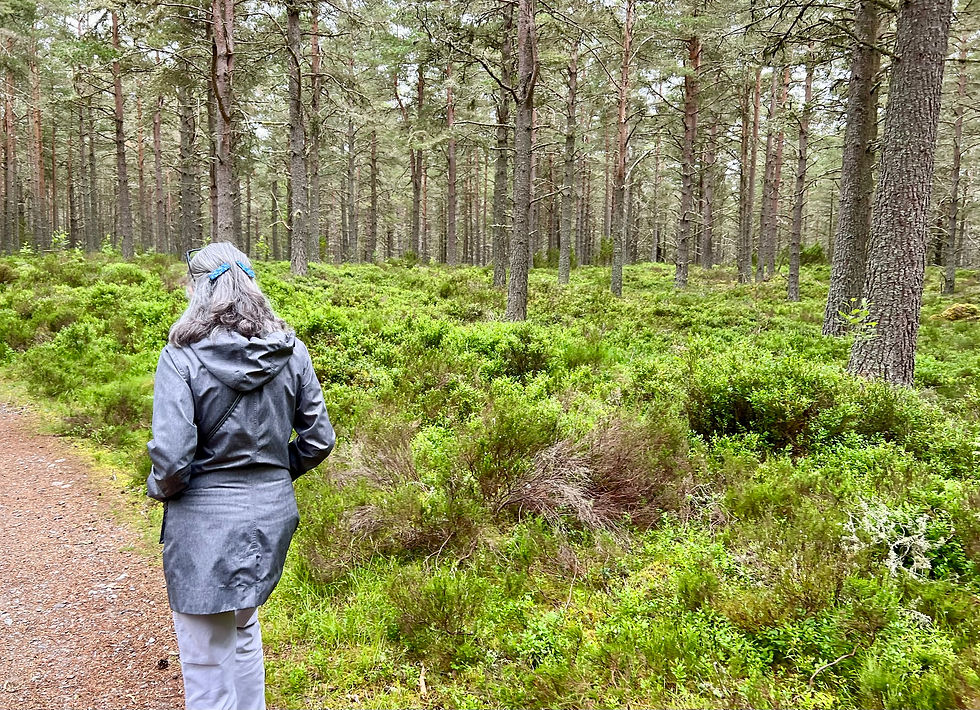
There was something mystical about these woods. Like many Scottish forests, the trees were tall but there was surprisingly little undergrowth. Instead, we could see clearly through the trunks along a carpet of ferns stretching into the distance. It was quiet, green, and slightly otherworldly.

We continued on to Aviemore, the commercial center of the Cairngorms and a base for outdoor activities ranging from hiking and rock climbing to biking and skiing. It was noticeably more touristy than the places we’d been staying. We ducked into souvenir shops to escape the intermittent showers, then stopped for a casual coffee and carrot cake, watching the other tourists dart around in the drizzle.
That evening we walked about five blocks through a Grantown residential area to dinner at the Craiglynne Hotel, sharing the restaurant with several busloads of older German tourists. It had the feel of an upscale cafeteria. After dinner we settled into the bar, watching the patrons who were watching the World Cup—only to be interrupted by a ceremonial Scottish bagpiper.
The Germans must love it.
The next day we returned to Aviemore and drove to Loch an Eilein. The loch had lovely trails around it and a ruined castle sitting on an island. The area is a popular recreation destination for Scots, with campsites scattered around nearby Loch Morlich.
Above the lake was one of Scotland’s few ski resorts, so we drove up the mountain on winding roads marveling at the views. There was still snow on the summit. The higher we climbed, the more the weather deteriorated, with strong gusts and bursts of rain sweeping down from the snowpack.
Back in Aviemore, we stopped at a hotel pub for an early drink at a hotel that looked promising for dinner. While glancing up at the cricket game playing on television, the Scotsman nearby asked if I was a baseball fan. He likely heard my accent and I ended up in an impromptu conversation about sports and various destinations in the United States.
It was another example of something we’d begun to appreciate about Scotland: conversations seemed to happen effortlessly. You didn’t necessarily have to know someone to talk to them. Sometimes all it took was sitting at the next table.
We also learned an important lesson that evening. If you want to eat dinner in Aviemore, you really, really need a reservation. The hotel restaurant couldn’t take us.
There were too many tourists and not enough restaurants. We wandered into several places, only to be told they were full. Eventually we found a restaurant that took pity on us.
By this point, the driving had also become much easier. Between our excursions around Dunning, the trip to Grantown, and our explorations of the Cairngorms, I’d become considerably more comfortable behind the wheel.
The distances in Scotland aren’t actually very great. The country is only about half the size of Wisconsin. But the roads are narrow and curvy, which makes even relatively short journeys take longer.
I was beginning to realize that this was part of the appeal. You couldn’t rush through Scotland even if you wanted to.
Along the River Spey
Sunday, June 28, began with our last breakfast at Ravenscourt. The inn was run by a couple, their two adult children, and a few friends who helped out. It had the comfortable, hospitable, with the slightly informal feel of a close-knit family who loved their business and their guests.

Since we didn’t have to arrive at our next house-sit until five, we had time for one more outing in Grantown. We wandered the Anagach Wood trails beside the River Spey, following the water near an old stone bridge. The paths were bordered by fields filled with purple lupine flowers.
Before leaving town, we stopped at a local bakery for coffee and cake, sitting outside and sharing the sidewalk with a motorcycle club apparently heading out for its own Sunday adventure.
Then we headed north.
Because it was on the way, we stopped in Aberlour for a short walk to see the noteworthy Linn Falls. We found a group of local teenagers swimming in the pools beneath them. It was another reminder that these beautiful places weren’t simply tourist attractions. They were part of everyday life for the people who lived here.
Eventually we continued toward our second housesit.

The final approach was more dodgy than I’d expected. The road narrowed to a series of one-lane stretches, and the final mile was unpaved. The house was called Pine Lodge, since there was no street name or number. We eventually found it and met Iain and Jane, along with their two dogs, Cody and Rebus, and cats, Josh and Dante. They were taking the two dogs with them for a course-running competition. We just had to look after the cats, who had freedom to go outside at their pleasure.
They gave us a tour of the house, and we chatted over dinner. Iain immediately gave me a sense of ease and familiarity. He was a retired RAF Tornado fighter pilot and had subsequently worked for British Aerospace, as I had. He had also worked as a contractor for BAe in Saudi Arabia, which meant he and Jane had spent long periods apart.
Our conversation ranged widely. We talked about Scottish separatism, the National Health Service, the use of Gaelic, and the surrounding countryside. Iain had been to the United States and had even hiked the Grand Canyon. Jane had never been, and wasn’t sure she wanted to go.
As with Patrick and Daisy, I detected a subtle discomfort with America.
We had established our anti-Trump credentials early in both housesits, so politics wasn’t an issue between us. Not outright, of course. That would be rude. And Brits are rarely rude. Just some offhand comments. There seemed to be a genuine love-hate relationship with the United States. From a distance, I sensed they admired American contributions but were also wary of its influence.
Jane asked whether we drank, apparently because she’d encountered American teetotalers. She also pointed out that we weren’t using our knives during dinner—an American tell I’d never heard of before. It was a fascinating glimpse into how we are perceived from the other side of the Atlantic.
The houses in the two sits couldn’t have been more different. The Dunning house—Latchburn Ford—had been surrounded by manicured gardens and filled with art, antiques, and collectibles. Pine Lodge was more modest and remote, surrounded by dense evergreen woods and fields. It was clean and tidy, but otherwise felt like a typical suburban American home.
There was another difference. Patrick and Daisy had several children and a brood of grandchildren, so framed photographs and family memories filled their house. Iain and Jane had never had children. Their photographs and artwork instead centered on themselves and their animals, in whom they took enormous pride.
When they showed us around their home to brief us on the mechanics, we faced some technology we’d never experienced: ‘Neff’ appliances that operated under different logic. Creative, but a little confusing. We were also again faced with the usual U.K./European method of clothes drying. Most people hang their clothes out to dry, or in inclement weather, somewhere indoors. While there are ‘dryers,’ they operate by sucking the water out of clothes into a reservoir that needs to be emptied, rather than using heat to evaporate the water. It takes additional time and some getting used to.
Before Iain and Jane left, Jane sheepishly admitted that the surrounding fields were full of ticks. She showed us a little tool for removing them and demonstrated how to use it on the dogs, which had already picked up a few in their morning romp. We would eventually remove several from the cats as well.

And so, after more than a week in Scotland, we were settling into another version of slow travel: a remote house, a couple of animals to care for, and an entirely different corner of the country to explore.
The scenery had changed. The pace had not.
Settling into Craigellachie
On Monday, June 29, Iain and Jane packed up their trailer, loaded the dogs, and left us to settle into Pine Lodge.
We drove to Elgin and found a place to eat downtown. It was a good-sized working town and clearly the destination for serious shopping for miles around. After lunch we explored the main commercial district, which didn’t take long. The more we walked, the dowdier it became.
Because Elgin felt more like a working town than a tourist destination, I noticed something I’d picked up in several other places. Europeans generally tend to dress better than Americans, and even the English seem to have a bit more style. But many Scots dress much like their American counterparts. There were plenty of oversized T-shirts, athletic shorts, and sneakers that would have been completely at home in an American Costco.
Snobby of me, I know. But once you see it, you can’t unsee it.

Leaving Elgin, we drove to Lossiemouth for a brisk walk along the northern coast. It was windy and chilly, and although we wore layers, there were Scots walking around in shorts and T-shirts who apparently thought it was balmy.
Before heading back, we stopped at Tesco for groceries. We’ve become experts at this grocery part of housesitting. Homeowners usually leave some basics and condiments, but sitters are expected to provide their own meals. After several housesits, Martha and I had developed a basic shopping list and can instinctively grab what we need.
Tesco itself was another small cultural adjustment. It is roughly the British equivalent of Walmart: brightly lit aisles of groceries and liquor, along with clothing and all sorts of non-food merchandise.
It was convenient, of course, but also a little incongruous. You could drive through a village of old stone houses and historic buildings, turn a corner, and suddenly encounter a glaring metal commercial building surrounded by a parking lot and shopping carts.
Perhaps that was another example of American influence. Convenient, certainly. But not always pretty.
By Tuesday, June 30, we’d settled into life with the cats. We lounged around the house, Martha worked on a jigsaw puzzle, and I puttered with my writing.
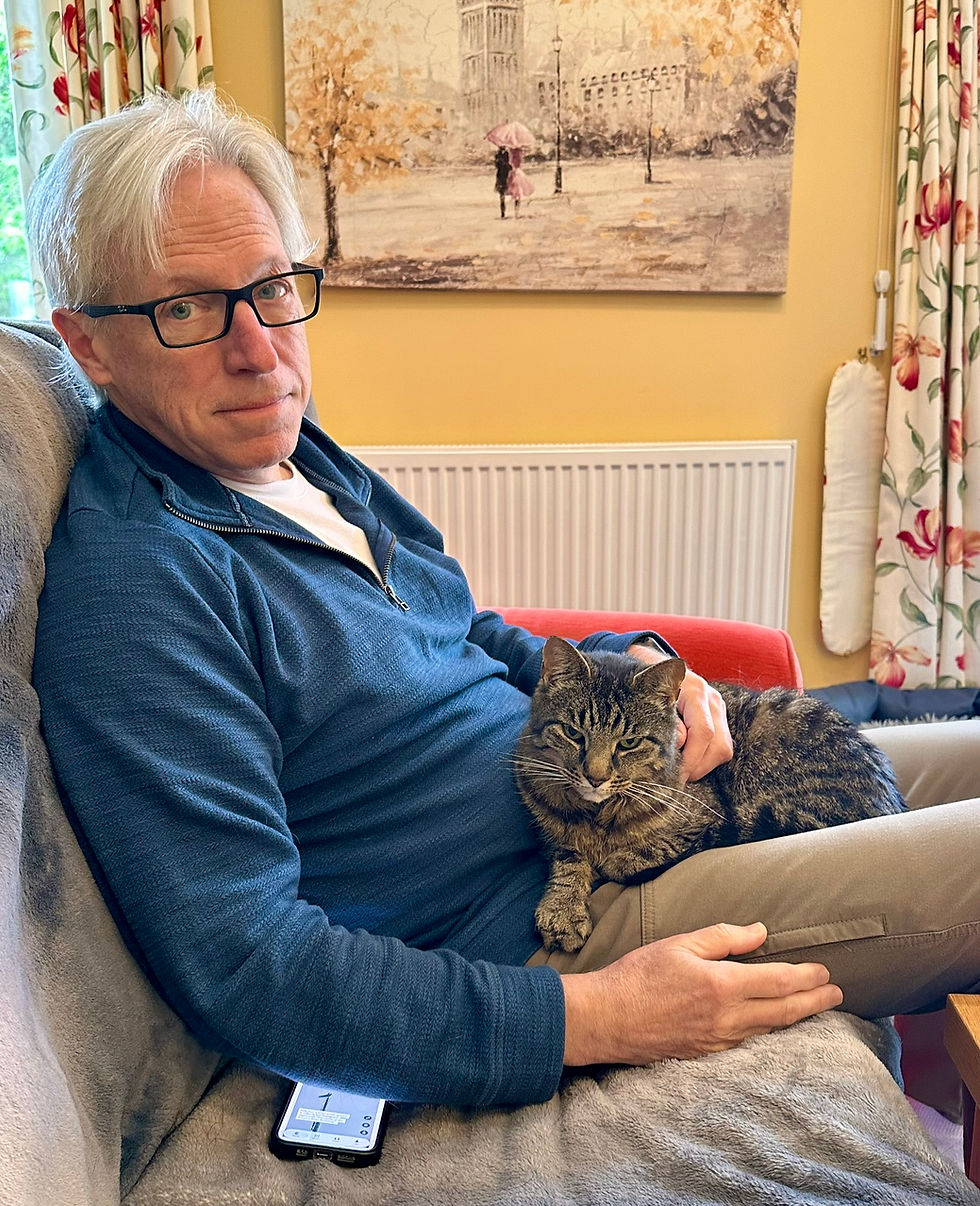

Housesitting pets comes naturally to us. Martha and I are animal lovers and certainly love dogs, but we’re especially sensitive to cats. Josh and Dante were two darlings. Josh was an older Tabby and loved to curl up in a lap and purr. Dante was a younger black male with an endearing quirk of taking walks with a human. He’d clearly urge me to the door and then follow wherever I walked through the area.

That evening we took a short drive to the Craigellachie Hotel and its Spey Inn for dinner. Afterwards, we had dessert in the hotel’s illustrious Quaich Bar, which advertised 700 different types of Scotch whisky. The bartender admitted it was probably closer to 500.

Once again, we were struck by how few people were there, especially since it was the height of tourist season.
Into Whisky Country
Our housesit was in the heart of Scotch whisky country. Speyside is, in fact, a distinct whisky-producing region, named for the River Spey, which we’d followed north from Grantown.
The river runs past Craigellachie and Dufftown, and everywhere we drove we seemed to encounter another distillery. The scenery could be almost comically Scottish. We’d pass fields of sheep or cows, round a bend, and suddenly find ourselves barreling past a collection of large stone buildings producing some of the most prestigious whisky in the world.
So, naturally, I scheduled a tour of the Glenfiddich distillery. How could we not?
Glenfiddich is one of the largest distilleries in Scotland. Tours ran almost every hour, and there were several other visitors in our group. The operation occupied several buildings, many of them constructed from the traditional stone found everywhere in Scotland.
It was clearly a major production facility but was remarkably clean and orderly.
At the end of the tour came the tasting. Since I was driving, I was given a nicely packaged set of samples to take home. Martha did the tasting and gamely tried it.
Before we left, we walked down a path to Balvenie Castle, a set of ruins that we paid a modest fee to explore.
And again, almost no one was there. Perhaps Scottish castles don’t seem quite as exotic to people who live among them. Martha later looked it up and discovered that, depending on how they’re counted, Scotland has up to 3,000 castles, ranging from ruins to functioning family estates. When you have that many castles, I suppose you can be nonchalant about it.
We drove into nearby Dufftown and had lunch at a cute little café called the Cozy Coo. The name was a play on the local Highland cattle—the shaggy, horned cows that are so distinctive to Scotland.
“Coo” is Scottish for cow. Get it?
The Moray Coast

On Thursday, July 2, Martha wanted to explore the Moray Coast, the northern shoreline along the North Sea. I’d seen a video about an unusual rock formation there, so we headed
toward Buckie and then east to stop in Findochty and Portknockie.

The roads wound through narrow village streets before opening onto a seaside park. From there, trails crossed low vegetation toward the coast and the Bow Fiddle Rock. The formation was staggering—much larger and more dramatic than photographs suggest.
Unfortunately, it was also incredibly windy and cold, so we didn’t linger.
The next day I came down with a nasty cold, so we stayed closer to home, driving the short distance into Craigellachie and picking up a trail Iain and Jane had recommended that followed the River Spey toward Aberlour.


Along the way we stopped at Craigellachie Bridge, a local landmark that is now closed to road traffic. A sign described a ceremony held there some thirty years earlier in which a member of the royal family joined local musicians to honor the bridge. It prompted another chuckle over the British fascination with pomp and ceremony.
Findlater Castle
By Saturday, July 4, I was feeling better, and Martha plotted another trip to the Moray Coast. We’d been driven away by the wind during our previous visit, so this time she chose Findlater Castle near Cullen.

Driving among the villages of the Moray Coast, we were intrigued by the distinct housing design. While much of Scotland’s housing stock is simple
gray stone, the homes along the winding streets of the coast were often whitewashed with colored geometric, quilt-style squares on the facades. It felt more like a Nordic influence, which would make perfect sense on the North Sea.
Approaching the castle, there was almost no indication it was there. We walked through fields of grain waving in the wind along a narrow path. Then the ground suddenly dropped away, and the ruins appeared on a rocky promontory overlooking the sea.
Waves crashed against bright green cliffs below us. The wind rustled through the short flowers and heather. Beyond the ruins was nothing but the North Sea.
The atmosphere was serene and almost mythic. It was one of the most beautiful—and unexpectedly spiritual—places I’ve ever visited. There was something about the combination of the ruins, the sea, the wind, and the almost complete absence of other people that made the place feel timeless.
Only later, after we’d returned home, did I discover that the recent film The Odyssey had used the Moray Coast and Findlater Castle as locations. That explained the autographed photographs of Matt Damon on the wall of a hotel in Cullen we’d stopped by.
Our reason for stopping there, however, had nothing to do with Matt Damon. We were looking for a restroom. That turned out to be another pleasant surprise about Scotland: the ease of finding and using public restrooms. In some parts of Europe, using a hotel or restaurant restroom when you’re not a customer can be frowned upon. Sometimes there’s even a charge.
In Scotland, restrooms seemed to be everywhere. Shops and restaurants generally made them accessible to anyone who needed one. A small thing, perhaps, but after several weeks of travel, small conveniences become memorable.
Ballindalloch
On Sunday, July 5, Martha—ever the tour director—found another castle estate to visit. This time it was Ballindalloch, a much more recent and polished example of the Scottish country estate.
The place was grand and sophisticated, and the family still lived there, as they did at Blair Castle. Our first stop was the walled garden, which contained some remarkable plantings. Gardening seems to be a pastime, art form, and way of life in Britain, and the expertise evident in some of the gardens we encountered was impressive.
Ballindalloch was clearly an ancestral home that had been opened to visitors to help support its upkeep. No picture-taking was allowed inside. The rooms were elaborate, though the interiors struck me as stuffily staged—like the perfect home of a wealthy family in the 1950s—as we gawked from velvet ropes at the doorways of each room.
There was a distillery, of course, along with several other businesses associated with the estate.
Driving away, we spotted signs for Pictish stones and wandered down a lane to a small church where several artifacts dating back roughly 3,000 years were on display in alcoves of a country church.
We were completely alone. By now, that almost seemed normal. That was one of the most striking things about Scotland. We were surrounded by places that, in the United States, would likely be major tourist attractions. Yet here we could wander through ancient ruins, historic estates, castles, forests, and archaeological sites with barely another person in sight, all without tacky food stands and tourist stops.
The country seemed to have an extraordinary amount of history—and somehow enough room for all of us to experience it without standing in line.
And somewhere along the way, our housesit in Craigellachie had stopped feeling simply like a place we were staying and more like a residence.
The Road to Inverness
Monday, July 6. Time to go.
Jane and Iain would be returning home within a few hours, so we cleaned up the house, packed our bags, and said goodbye to Josh and Dante.
Our next—and last—stop was Inverness, the largest city in the Highlands, with a population of roughly 50,000. It is often described as the gateway to the Scottish Highlands.
We made a couple of stops along the way. Martha is a fan of the Outlander series, and the Culloden Battlefield figures prominently in its conclusion. The battle, fought in 1746, was the final confrontation of the Jacobite Rising and the last pitched battle fought on British soil. The government forces, largely English, defeated the Jacobites, many of them Highland Scots, in a brief and lopsided engagement.

In the space of a couple of hours, the Jacobites lost perhaps 1,500 to 2,000 men, compared with roughly 50 government casualties. Yet despite its brevity, Culloden became legendary and remains deeply embedded in Scottish history and identity.
The battlefield now has a large visitor center with sophisticated displays, a restaurant, and the inevitable gift shop. It was one of the few places we’d visited where tourists were actually plentiful. All that attention for a battle that was over in a matter of hours.
From Culloden, Martha had us make another Outlander pilgrimage to Clava Cairns.
Clava Cairns is an ancient site of stone burial mounds and standing stones thought to date back roughly 4,000 years. Its original purpose is uncertain, although it may have been used for burials or religious ceremonies.

In Outlander, the heroine places her hands on one of the standing stones and is transported back in time to the eighteenth century. Naturally, Martha recreated the scene.
Inverness
From Clava Cairns, it was only a short drive to Inverness.
We checked into the Blackfriars, dropped our bags, and I headed off to the Enterprise outlet to return the car. I did so with a genuine sense of relief—and accomplishment.
The car was no longer a liability. I’d managed to drive on the left, navigate the roundabouts, negotiate narrow roads, decipher unfamiliar signs, and survive the occasional one-lane road without incident. What had seemed so intimidating before the trip had gradually become almost routine. I was still happy to give the car back.
Blackfriars had a nice configuration: an inn with a pub and restaurant on the first floor and our room conveniently upstairs. It was more in keeping with the traditional British inn concept than some of our earlier accommodations.
That turned out to be particularly useful that rainy evening. We didn’t have to go anywhere. We could simply walk downstairs, have dinner, and collapse. We’d deferred on some of the more traditional Scottish dishes—like haggis. But on this evening Martha went for the local Cullen Skink (fish chowder) and declared it delicious.
The next morning, we explored central Inverness. The purpose was less to see major attractions than to stretch our legs, get a feel for the city, and do some last-minute shopping.
At this point we’d seen enough old churches, historic buildings, and archaeological sites. We passed on the signature castle, with its expensive admission fee, and made a quick visit to a local art museum that left us underwhelmed.
We’d deliberately delayed buying souvenirs and gifts for the boys, especially knowing that Inverness would provide plenty of opportunities. It did. There were scores of shops selling Scottish trinkets and, especially, wool scarves. Scarves everywhere. Different brands. Different patterns. Different prices. Which, I suppose, explains all the sheep.

Several shops also sold Scottish formal wear—kilts and jackets. During our housesits, I’d noticed wedding photographs in which the men were actually wearing them. They weren’t some quirky tourist novelty. Kilts really are men’s formal wear.

Tiring of the tourist drill, we took a diversion to Leakey’s Book Store, a quirky multi-level novelty attraction of a shop with historic graphics, maps, and old books.
One Last Scottish Evening
Perhaps we were already mentally transitioning toward home, but that evening we opted for a Turkish restaurant for dinner called Aspendos.
Afterward, we passed a music/pub venue called Hootananny, and Martha suggested we check it out. It was crowded, but we managed to get drinks and found ourselves caught up in the raucous energy of a traditional Scottish band.

We were trying to find a place to stand when a young fellow sitting at a table pointed toward some empty seats at his table and invited us to join him. He turned out to be Irish, traveling through the northern Highlands with his girlfriend. Over the music, we compared notes about America and Scotland. Once again, I was struck by how easily conversations with strangers seemed to happen. It didn’t matter that we’d just met. It didn’t matter that we were Americans and they were Irish. We were simply people sharing a pub and a good band.
It was a fitting final evening in Scotland.
Heading Home
Our flight the next morning, July 8, was from Inverness to Heathrow, where we’d connect to Dulles. The first flight left at 7:30, so we were up early and took a taxi to the little Inverness airport. The flights were predictable and relatively comfortable.
And then, suddenly, we were home.
Martha and I both came back completely smitten with Scotland. There is a mystical, rural quality to the country—old stone buildings scattered across rolling landscapes, villages that seem to have grown organically from the countryside, and a history that is almost impossible to escape.
But the people made it even more enchanting. Everywhere we went, conversations seemed to happen naturally. Maybe it was the open space and lack of crowds, but there was an easy quality to life there—a slower pace that we found increasingly appealing.
The trip also reinforced our approach to travel. Housesitting allows us to slow down. Rather than spending a few days in a hotel, racing around to see the major attractions before moving on to the next city, we settle into a place and briefly live like locals.
We walk the neighborhood. We shop at the local store. We go to the pub. We meet the people who live there. We discover the places that aren’t necessarily in the guidebooks.
And we don’t have to see everything.
That approach avoids much of the stress—and expense—of conventional travel. Constantly packing and unpacking, checking into hotels, rushing to fit attractions into a tight schedule, then moving on to the next destination is exhausting. Especially as we get older.
Our time in Scotland reinforced the idea that we’d rather experience fewer places more deeply than collect a long list of places we’ve visited.
Three and a half weeks had gone by surprisingly quickly. We had arrived as tourists. We left feeling as though we’d briefly been residents.
And unlike most trips, coming home didn’t bring quite the usual sense of relief that the adventure was over. We missed Scotland. The quiet roads. The village pubs. The sheep-filled hills. The ancient ruins. The spontaneous conversations. The whisky. Even the rain. Scotland had gotten under our skin.
And before we’d been home very long, we were already thinking about returning.
Maybe Scotland again.
Maybe Ireland.
But wherever we go next, I suspect we’ll be looking for the same thing:
A place where we can slow down long enough to feel, however briefly, that we belong there.


Comments